
Guide: How Can I Get a Work Visa for Canada for Nigerians?
So, you're thinking about getting a Canadian work visa? It's a fantastic goal, but for most Nigerians, the first step is figuring out which pathway is the right one for your specific situation. It usually boils down to two main options: the Temporary Foreign Worker Program (TFWP) and the International Mobility Program (IMP).
Each one is designed for different types of workers and job offers, and knowing the difference is half the battle. This isn't just about paperwork; it's about strategy.
Your Canadian Work Journey Starts Here

For many of us dreaming of working in Canada, the process can seem overwhelming at first glance. It's easy to get lost in all the acronyms and paperwork. But once you break it down, it's a lot more straightforward than it looks.
The biggest difference between the TFWP and the IMP hinges on a single, crucial document: the Labour Market Impact Assessment (LMIA).
What on Earth is an LMIA?
Think of an LMIA as official proof from a Canadian employer. It essentially says, "We tried to hire a Canadian or permanent resident for this job, but we couldn't find a suitable candidate." This document is the heart and soul of the TFWP.
If your potential employer needs to get an LMIA, it's usually because they're trying to fill a labour shortage. This is a very common route for Nigerians in fields like long-haul truck driving, healthcare (especially caregiving roles), and skilled trades like welding or construction.
On the flip side, the IMP is for situations where your work benefits Canada in a different way. This could be because you're transferring within a multinational company from its Lagos office to its Toronto branch, or because you have highly specialised tech skills (like in AI or cybersecurity) that are in serious demand. These jobs are LMIA-exempt, which can often speed things up.
The path you take is decided by the job offer you get. An LMIA-based offer automatically puts you in the TFWP stream. An LMIA-exempt offer puts you in the IMP stream. Grasping this distinction from the start is absolutely critical for a smooth application.
Canada Work Visa Pathways at a Glance for Nigerians
To help you see the difference more clearly, I've put together a simple table. It breaks down the main visa types, what they require, and the typical processing times so you can figure out which path makes the most sense for you.
| Pathway | Key Requirement | Best For | Typical Processing Time |
|---|---|---|---|
| Temporary Foreign Worker Program (TFWP) | Positive LMIA from a Canadian employer | Workers in occupations with proven labour shortages (e.g., healthcare, construction, truck driving) | 4-8 months (including LMIA processing) |
| International Mobility Program (IMP) | LMIA-Exempt Job Offer | Workers with specialised knowledge (e.g., IT specialists), intra-company transferees, or post-graduates | 2-5 months |
As you can see, the timelines and requirements vary quite a bit. Your job offer is your ticket, and it dictates the entire process.
Choosing Your Pathway
Navigating these streams is the core of the work visa application for any Nigerian. It’s also worth remembering that Canada’s immigration policies are always being updated to manage the number of temporary workers while still meeting the country's economic needs. Because of this, having a clear strategy right from the beginning is your best bet for success.
For a much deeper dive into the entire relocation process, you might find our complete guide on how to relocate to Canada from Nigeria really helpful.
Confirming You're Eligible for a Canadian Work Visa
Before you spend a single Naira on application fees or invest weeks chasing down documents, let's have a frank chat. Thinking about getting a work visa for Canada starts with a hard look in the mirror to confirm you meet the basic, non-negotiable requirements. This isn't just about ticking boxes; it's about building a convincing story for the visa officer from the very beginning.
At the end of the day, the Canadian government needs to be sure of two things: you won’t become a burden on their system, and you will leave when your permit expires. Every single document you submit needs to back up these two points. Let's break down what this really means for you in Nigeria.
Demystifying Proof of Funds
This is where a lot of Nigerians get stuck. Canadian officials want to see that you can support yourself when you first land, long before your first Canadian paycheque comes in. There's no magic number, but a good rule of thumb is to have the equivalent of C$3,000 to C$5,000 ready.
At the current exchange rate, that's a significant amount of Naira. The key isn't just having the money—it's proving where it came from. A large, sudden deposit into your account right before you apply is a major red flag. It just looks suspicious. Think about it: if ₦5 million suddenly appears in your GTBank account from an unknown source, it raises questions.
Instead, you need to show a consistent financial history. Here’s how you can present your funds convincingly:
- Bank Statements: You'll need at least four to six months of official bank statements. Don't just print the transaction history from your banking app. Go to your bank and get the properly stamped, official documents.
- A Clear Narrative: It helps to include a short letter explaining your financial situation. Make the visa officer's job easier by converting your closing balance to Canadian dollars. If you have significant savings in a mutual fund or a fixed deposit account, provide statements for those too.
- Sponsorship: If a family member is sponsoring your trip, you'll need a formal letter of sponsorship from them, their own bank statements, and solid proof of your relationship (like a birth certificate).
This financial proof tells the visa officer you’ve planned your move properly and won’t be left stranded on arrival.
Proving Your Strong Ties to Nigeria
Honestly, this might be the most critical part of your entire application. You have to convince the visa officer that you have compelling reasons to return to Nigeria after your work permit expires. Think of it as leaving some serious collateral behind.
For Nigerians, these ties can be shown in very specific ways. Vague statements won’t cut it; you need concrete evidence.
Your goal is to paint a picture of a stable, established life in Nigeria that you fully intend to return to. The more evidence you provide, the stronger your case becomes. It's about showing you have too much to lose by not coming back.
Consider these powerful examples of ties:
- Family Responsibilities: Are you caring for elderly parents in Abuja? Are your spouse and children staying in Nigeria while you work abroad? Provide proof like birth certificates, marriage certificates, and a letter explaining your family situation.
- Property Ownership: Owning property is a massive anchor. If you own land or a house in Lagos, Port Harcourt, or anywhere else, include the title deeds or deed of assignment in your application.
- A Stable Job: A letter from your current Nigerian employer is excellent evidence. It should state that you are on an approved leave of absence and are expected to return to your position. This shows you have a career waiting for you back home.
- Business Ownership: If you run your own registered business, be sure to include your Corporate Affairs Commission (CAC) documents and business bank statements.
Navigating the Medical Examination
Finally, every applicant has to go through a medical examination. This is not something you can do with your family doctor down the road. You must book an appointment with a "panel physician" who has been approved by Immigration, Refugees and Citizenship Canada (IRCC).
There are several approved clinics in Nigeria, mostly located in Lagos and Abuja. The exam itself is pretty straightforward. It usually includes a physical check-up, blood tests, and a chest X-ray to screen for things like tuberculosis.
The best part? The results are sent directly to IRCC by the physician’s office, so you don't have to worry about submitting them yourself.
By carefully preparing your proof of funds, demonstrating strong ties to home, and getting your medicals done, you build a solid foundation for your Canadian work visa application.
How to Secure a Genuine Canadian Job Offer

For most Nigerians, this is where the real work begins. Getting a legitimate Canadian job offer is the single most critical step in the entire process, but you're up against some serious competition. Let's be honest, generic advice won't cut it. You need a solid game plan.
First things first, you have to completely overhaul your CV. The typical Nigerian CV format—the one with your date of birth, state of origin, and a headshot—is a non-starter in Canada. It will get your application binned almost instantly. Why? Canadian hiring practices are designed to prevent bias, so including these personal details is seen as unprofessional.
Your new CV needs to be a sharp, achievement-focused document. Stop listing your duties and start showcasing your accomplishments. Use real numbers to prove your impact. For instance, don't just say "Managed social media." Instead, write something powerful like, "Grew social media engagement by 45% in six months by developing and executing a new content strategy." See the difference?
Adapting Your CV for the Canadian Market
To get a Canadian recruiter to actually read your CV, you need to do more than just remove personal details. Think of it as translating your career story into a language they understand and respect.
- Lead with Your Strengths: Start with a punchy professional summary that highlights your top skills and biggest wins. Use bullet points and strong action verbs.
- Quantify Everything: Numbers are a universal language. Managed a team? How many people? Handled a budget? How much was it? Improved a process? By what percentage? Put a number on it.
- Customise Every Single Time: This is non-negotiable. Don't mass-send the same CV. Read the job description carefully and mirror its keywords and language. It shows you're serious and not just spamming applications.
This approach shows you understand the professional culture and you're ready to hit the ground running. It's also worth looking into proven strategies that can help expedite your job search and get your application noticed.
Leveraging the Right Job Search Platforms
Of course, you'll be using platforms like LinkedIn and Canada's official Job Bank. But your strategy needs to be smarter than just clicking "apply" on hundreds of listings. That’s a fast track to burnout. The real magic happens when you start building connections.
Reach out to other Nigerians who are already working in your industry in Canada. A simple, polite message on LinkedIn can be surprisingly effective. Don't ask for a job—ask for advice. People are often happy to share their journey, and these chats can lead to inside information on unadvertised roles.
The hidden job market is very real in Canada. Many of the best roles are filled through referrals. Networking with other Nigerian professionals who have successfully made the move is your most powerful strategy. They've walked the path you're on and can offer invaluable insights.
Identifying Legitimate Opportunities and Avoiding Scams
Sadly, where there's high demand, there are scammers. You have to learn how to spot the red flags from 'ghost consultants' and fake job offers to protect yourself.
A real Canadian employer will never ask you to pay for a job offer. They will also never ask you to cover the fees for a Labour Market Impact Assessment (LMIA). By law, those costs fall on the employer. If anyone asks you for money for a job, walk away. It's a scam, period.
On the flip side, a massive green flag is the mention of an LMIA. A genuine employer will know all about this process. If they can give you a positive LMIA number, you can feel confident the offer is legitimate. It's the Canadian government's stamp of approval, confirming the employer has permission to hire you.
Be sceptical of any offer that seems too good to be true, comes from a generic email address (like Gmail or Yahoo), or pressures you into a quick decision. Always do your research and verify the company's existence before you get your hopes up.
Your Nigerian Document Checklist for Canada
Getting your documents in order isn't just a step in the process; it's the very foundation of your application. Think of it this way: a single missing paper or a poorly filled-out form can bring your Canadian dreams to a screeching halt. Let's walk through the ultimate checklist, built from the ground up for the specific hurdles Nigerians face.
We’re going to break down every critical document. I won’t just tell you what you need, but I'll show you how to get it right by Canadian standards. This is about more than just ticking boxes—it's about building a rock-solid, convincing case for the visa officer reviewing your file.
The Essential Police Clearance Certificate
First up, the Police Clearance Certificate (PCC). Here in Nigeria, we call it the Police Character Certificate. This one is non-negotiable. It's your official proof to the Canadian government that you don't have a criminal record that would make you inadmissible.
You'll need to get this sorted through the Nigeria Police Force Criminal Investigation Department (CID). Your best bet is to apply at the police headquarters in your state or, if you're in Lagos, head to the Central Criminal Registry in Alagbon.
Here's what to expect:
- Biometrics: They will need to take your fingerprints.
- Required Documents: Make sure you have your valid Nigerian international passport, a few passport photos, and proof of your address.
- A Word of Advice: This process can take weeks, sometimes longer. Don't put it off. Apply for your PCC right at the start of your journey.
Getting Your Educational Credentials Assessed
That degree from the University of Ibadan or your HND from Yabatech is a massive achievement, but Canadian immigration needs to understand how it stacks up against their own system. That's where an Educational Credential Assessment (ECA) comes into play.
An ECA report from a designated organisation basically validates your Nigerian qualification, showing it's equivalent to a Canadian one. Most people use World Education Services (WES); it's the most recognized.
Honestly, the biggest headache for many Nigerians is getting their university to send transcripts directly to WES. This can be a painfully slow process. Contact your university's transcript office the moment you decide to apply. Some unis have improved, but many still operate on a timeline that requires you to plan far, far ahead.
A key takeaway for Nigerian applicants: The ECA process often takes much longer than anticipated due to transcript verification delays. Initiate contact with your university and your chosen ECA body (like WES) as soon as you decide to apply for a Canadian work visa.
Crafting a Compelling Reference Letter
Listen, a standard reference letter from a Nigerian employer often isn't good enough. Canadian visa officers are looking for very specific details that prove your work experience is a match for the job you've been offered. A generic letter saying you were a "hardworking employee" is completely useless.
Your reference letter absolutely must be on official company letterhead and include:
- Your full name and job title.
- The exact dates you worked there.
- Details on your salary and any benefits.
- A detailed list of your main duties, written with strong action verbs.
- The contact information for your manager or HR.
The duties you list must align perfectly with the lead statement and job description for your National Occupational Classification (NOC) code. This is how you directly prove you have the right experience for the job waiting for you in Canada.
This is also a good time to remember that Canada's approach to immigration is strategic. The path for Nigerians is heavily influenced by policy changes and targets set by IRCC. For example, Canada's Immigration Levels Plan shows a strong focus on bringing in skilled workers to fill economic gaps. This means more opportunities for Nigerians who can clearly prove their qualifications. You can find more insights on these plans over at CanadaVisa.com.
Proving You Have Sufficient Funds
We've touched on this before, but your bank documents are a make-or-break part of this checklist. You'll need to provide clear, stamped bank statements for the last four to six months. Any large, sudden deposits without a clear explanation are a huge red flag. Your financial story must be consistent and easy to follow.
For a complete breakdown of exactly what's required, check out our detailed guide on proof of funds for your Canada application.
Mastering the IRCC Online Application Portal
The official Immigration, Refugees and Citizenship Canada (IRCC) portal is your main gateway for the application. To be frank, it can feel a bit overwhelming at first. Think of this section as your personal walkthrough, here to help you sidestep the common pitfalls that can delay, or even deny, your work visa application.
We're going to break down how to set up your profile, tackle the key forms without errors, and upload your documents just right. The goal? For you to hit that "submit" button with total confidence.
Creating Your Profile and Navigating the Forms
First things first, you'll need to create a secure IRCC account. This is your personal dashboard for the entire process—it's where you'll submit everything, get messages from IRCC, and track your application's status.
Once you’re registered, the system will guide you through a questionnaire. Your answers will generate a personalised checklist and the specific forms you need to complete.
For anyone applying for a work permit from outside Canada, the main document is the IMM 1295 (Application for Work Permit Made Outside of Canada). My advice? Take your time here. Go over every single detail twice—your passport number, your date of birth, everything. A simple typo can cause a world of trouble down the line.
From my experience helping Nigerian applicants, a couple of sections often cause confusion:
- Travel History: You must be completely transparent here. List every single international trip you've taken in the past ten years. Been to the UK, US, or Dubai? It all needs to go in. Forgetting a trip can be seen as misrepresentation, which is a very serious offence in the eyes of IRCC.
- Family Information (IMM 5707): This is another critical one. You have to declare all your immediate family members—spouse, parents, kids, and siblings. This is required whether they are coming with you to Canada or not. Be meticulous with their details.
A Pro Tip I Always Give: Don't try to fill out the entire application in one go directly on the portal. It can time out and you might lose all your hard work. The smarter move is to download the PDF forms, save them to your computer, and fill them out offline. You can then upload the completed forms when you're ready.
Uploading Your Documents Correctly
After the forms are done, you’ll move on to the document upload stage. The portal will show you a personalised document checklist based on your earlier answers.
Pay very close attention to the technical requirements for each file. They usually need to be in PDF, JPG, or PNG format and, crucially, under 4MB in size. You'll likely need to use a free online tool to compress some of your larger files, like scanned passport pages or educational certificates.
This checklist gives a good overview of the core documents you'll need to get in order.
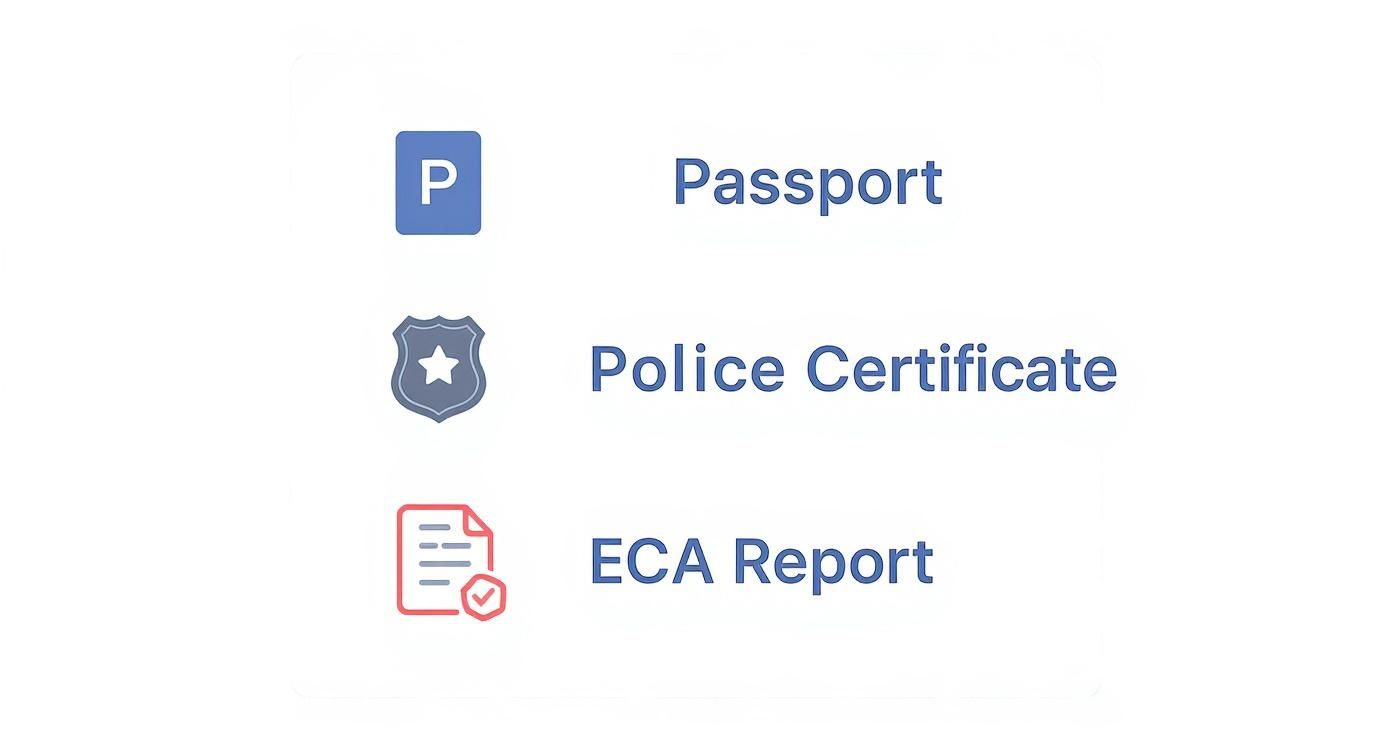
As you can see, critical paperwork like your passport, police certificate, and ECA report are the foundation of your application. Having these scanned and ready in the right digital format before you even start filling out the forms will save you a lot of stress.
The Biometrics Process in Nigeria
Once you've submitted your application online and paid all the necessary fees, you'll receive a Biometric Instruction Letter (BIL) in your IRCC account. This is not an optional step; it's mandatory.
With your BIL in hand, you must book an appointment at a Visa Application Centre (VAC). In Nigeria, the only two locations are in Lagos or Abuja.
These appointments can get booked up weeks in advance, so don't delay. As soon as that BIL arrives, get online and book your slot.
On the day of your appointment, you will need three things:
- Your valid international passport.
- The Biometric Instruction Letter (BIL) you printed out.
- Your appointment confirmation letter.
The process at the VAC is usually very efficient. They'll take your fingerprints and a digital photograph, and that's it. This information is then automatically linked to your online application. From this point on, the real waiting game begins. It's worth remembering that while Canada has ambitious immigration targets, the number of work permits issued can fluctuate with policy changes. You can see these immigration statistics and trends on Canada.ca, which underscores why a perfectly submitted application is more important than ever.
So, you’ve hit submit. What now?
This is where the real waiting game begins, and honestly, it can be the most stressful part of the entire journey. It helps to have a clear picture of what’s happening on the other side. Right now, your entire file is with an Immigration, Refugees and Citizenship Canada (IRCC) officer.
First, they'll do a quick check to make sure everything is there. They call this a "completeness check." If you've missed a major document, they might just send the whole application back to you, unprocessed. Assuming it passes that first hurdle, it officially enters the queue for a detailed review. Processing times can be all over the place, so your best bet is to keep an eye on the official IRCC processing times tool for the latest estimates for applications from Nigeria.
Keeping Tabs on Your Application
The easiest way to see what's going on is through your secure IRCC online account. The status updates are usually pretty simple – you’ll see it go from "submitted" to "under review," and then, eventually, to a final decision.
It’s completely normal for the status to sit unchanged for weeks at a time, so try not to worry. What you do need to act on quickly is any communication from IRCC. They might send a request for more information – maybe a clearer copy of a bank statement or an extra form. Don't see this as a bad sign. It just means they're doing their due diligence and need a little more from you. Get them exactly what they’ve asked for as soon as you can.
Understanding a Potential Refusal
It's wise to prepare for any outcome, and unfortunately, refusals do happen. Knowing the common reasons why applications from Nigeria are rejected can help you avoid these pitfalls from the start.
Some of the most common reasons I’ve seen include:
- Weak ties to Nigeria: This is a big one. The officer wasn't convinced you have compelling reasons to return home after your work permit ends. Think family, property, a stable career path to come back to.
- Insufficient proof of funds: Your financial documents didn't paint a clear enough picture that you can support yourself when you first land in Canada.
- Misrepresentation: This is the most serious. It means you either provided false information or omitted something critical, like a past visa refusal from the UK or US. Honesty is non-negotiable here.
A visa refusal isn't necessarily the end of your Canadian dream. The refusal letter is your most valuable piece of feedback. It will have the officer's notes explaining precisely why they said no. This is your roadmap for what to fix.
If you face a refusal, you have a couple of options. You can take the officer's feedback, gather stronger evidence to address their concerns, and re-apply with a much-improved application. Alternatively, you could take a step back and see if another immigration pathway might be a better fit. The goal is to learn from the decision and build a stronger case for next time.
Answering Your Top Canada Work Visa Questions
Let's get straight to it. You’ve got questions, and I’ve heard them all before from fellow Nigerians navigating this process. Here are the answers to the most common concerns.
Can My Family Come with Me to Canada?
Absolutely, this is a very common and achievable goal. If you land a work permit for a skilled position (that’s any job falling under NOC TEER 0, 1, 2, or 3), your spouse or partner is often eligible for an open work permit. This is fantastic because it means they can work for almost any employer in Canada without needing a separate job offer.
Your dependent children can also come along and are typically able to enrol in Canadian schools. The key is proving you have enough money to support everyone when you first arrive.
How Much "Proof of Funds" Do I Actually Need?
There’s no magic number set in stone by IRCC, but from experience, you need to show you can handle your initial expenses without immediately needing to earn. A solid benchmark for a single applicant is to have the equivalent of C$3,000 to C$5,000.
At the current exchange rate, that's roughly ₦3 million to ₦5 million. This isn't just about having the money; it's about showing it's genuinely yours. The funds should be in an account you've actively used for at least a few months. For a family, you'll need to show considerably more.
What if My Work Visa Application is Rejected?
A rejection stings, but it's rarely a dead end. The first thing you must do is stop and carefully read the refusal letter. The visa officer will state the exact reasons for the denial—this is your guide on what to fix.
A rejection is disappointing but not always the end. First, carefully read the refusal letter to understand why. This is your roadmap for what to fix.
For many Nigerians, common reasons are failing to prove strong ties to home, not showing sufficient funds, or the officer having doubts about the authenticity of the job offer.
Once you understand the problem, you can gather stronger evidence to address those specific points and re-apply. A second application that directly fixes the previous refusal's weak spots has a much better chance. Only in very rare cases, where you're certain the officer made a legal mistake, should you consider a judicial review. For most of us, strengthening the application and trying again is the way forward.
Feeling overwhelmed? Get instant, accurate answers to your personal immigration questions. JapaChat is Nigeria’s first AI immigration expert, designed to give you the clarity you need. Start planning your journey with confidence today at https://japachat.com.
Leave a Reply