
EB2 Visa Requirements for Nigerians: Your Ultimate Guide
The EB2 visa is all about proving one of two things: you either have an advanced degree or you possess exceptional ability in your field. This isn't just a temporary work pass; it's a direct route to securing a U.S. Green Card, designed for professionals whose skills are in high demand in America.
Your Bridge to a US Green Card

For many talented Nigerian professionals, the American dream can feel like it's locked behind a maze of complicated visa rules. You might be a doctor in Lagos, a software engineer in Abuja's tech scene, or a business analyst in Port Harcourt, wondering if your expertise is the key to permanent residency in the United States.
The EB2 visa is that key.
Think of it less like filling out a standard visa form and more like being headhunted for a top international role because of what you bring to the table. It’s a prestigious path created for people with high-level qualifications. Unlike a temporary work visa that often ties you to a single employer, the EB2 leads directly to a Green Card, giving you and your family the freedom to live and work permanently anywhere in the U.S.
Who Is the EB2 Visa For?
Let's be clear, the EB2 visa isn’t for everyone. It's what's known as an employment-based, second-preference immigrant visa. Its main goal is to attract top talent whose work will benefit the United States.
This category is essentially split into two groups:
- Professionals Holding an Advanced Degree: This is you if you have a master's degree, a PhD, or even a bachelor's degree followed by five years of progressive, hands-on experience in your specialty.
- Individuals with Exceptional Ability: This route is for people who can show a level of expertise significantly above the norm in the sciences, arts, or business.
This visa is a formal acknowledgement that your advanced education or remarkable talent is a valuable asset. The great news for Nigerians is that this isn't just a long shot. The EB-2 visa category has consistently seen a high approval rate for Nigerian applicants, proving it's a very real possibility for qualified candidates who prepare their applications well.
Understanding Your Options
While the EB2 visa is a fantastic tool for skilled professionals, it's just one piece of the puzzle. For those who have significant capital to invest, exploring the EB5 visa for Nigerians presents an entirely different path based on investment.
However, for most skilled professionals, the EB2 remains the most direct route. If you want to get a wider view of the U.S. visa landscape, especially for technical roles, this guide can be quite helpful: Engineers' Guide to US Visas.
By getting to grips with the core EB2 visa requirements, you can start to figure out if your professional background is a match for this incredible opportunity to "japa" the right way.
Qualifying for the EB2 Visa: Advanced Degree vs. Exceptional Ability
The entire EB2 visa process really comes down to one thing: proving you fit into one of two specific categories. Think of them as two different gateways leading to the same destination in the U.S. Figuring out which gate you hold the key to is the first, and honestly, the most important step.
You need to show that you're a professional with either an advanced degree or what USCIS calls exceptional ability in your field. Let's get into what that actually means, using examples that a Nigerian professional would instantly recognise.
The Advanced Degree Pathway
For many Nigerians, this is the most direct route. It’s straightforward, relying heavily on your academic qualifications from Nigerian universities and your work history. USCIS defines an "advanced degree" in two main ways.
The most obvious one is holding a master’s degree, a PhD, or a similar postgraduate qualification. This could be your Master of Science from the University of Ibadan, a PhD from the University of Nigeria, Nsukka, or even a postgraduate degree you earned abroad. Your degree certificate is the star of the show here.
But what if you don't have a master's? This is where the second definition is a complete game-changer for so many experienced professionals in Nigeria.
USCIS considers a U.S. baccalaureate degree (or its foreign equivalent) followed by at least five years of progressive, post-baccalaureate work experience in the specialty field as the equivalent of a master's degree.
This is a massive point. Your Bachelor of Science from UNILAG or Covenant University, paired with the right work experience, can be just as valid as a master’s degree. The keyword to focus on is "progressive". You must be able to prove that your responsibilities, skills, and authority grew over those five years.
Example: A Lagos Tech Professional
Let's picture a software developer who graduated with a BSc in Computer Science from Lagos State University. Over the last six years, she's worked for a couple of FinTech companies in Yaba.
- Years 1-2: She started out as a Junior Developer, writing basic code and handling bug fixes for a payment app.
- Years 3-4: She was promoted to a Mid-level Developer role, where she started owning specific product features and even mentoring NYSC interns.
- Years 5-6: Now, she's a Senior Developer, leading a project team, designing system architecture, and making major technical decisions for a new product launch.
Her career path clearly shows that "progressive" experience. By getting detailed letters from her employers that spell out this growth, she can tick the "advanced degree" box without ever stepping into a master's programme.
The Exceptional Ability Pathway
This path is a different kettle of fish entirely. It’s less about the certificates on your wall and more about the real-world impact you’ve made in your field. This route is designed for people who have a level of expertise that’s significantly above what’s normally seen in the sciences, arts, or business.
You don't need to be a Nobel Prize winner, but you do need to bring strong evidence showing you're a leader or a standout talent. USCIS has a checklist, and you have to meet at least three of their criteria to qualify.
- Official academic record showing a degree, diploma, or certificate from a university or institution related to your area of exceptional ability.
- Letters from current or former employers documenting at least ten years of full-time experience in your occupation.
- A licence or certification to practise your profession (e.g., COREN for engineers, Medical and Dental Council of Nigeria for doctors).
- Evidence that you have commanded a high salary or other payment for your services, showing your exceptional ability.
- Membership in professional associations that require outstanding achievements from their members.
- Recognition for your achievements and significant contributions to your industry by your peers, government bodies, or professional organisations.
Example: A Nollywood Innovator
Think about a film director in Nollywood. She doesn't hold a master's degree, but her work has left a real mark on the industry.
- She has won two "Best Director" awards at the Africa Magic Viewers' Choice Awards (AMVCA). This counts as recognition for achievements.
- She's a member of the Directors' Guild of Nigeria, which requires a solid portfolio review and peer endorsement to gain full membership. This is membership in a professional association.
- Major Nigerian publications like BellaNaija and The Guardian have written articles praising her innovative filmmaking style and her films' box office success. This shows both recognition and significant contributions.
By gathering evidence for these three points, she can build a powerful case for her exceptional ability, meeting the EB2 requirements through a different, but equally valid, path.
To make it even clearer, let's put these two paths side-by-side.
EB2 Eligibility Pathways at a Glance
| Requirement Category | Advanced Degree Path | Exceptional Ability Path (Meet at least 3) |
|---|---|---|
| Primary Focus | Formal education and work experience. | Recognised expertise and industry standing. |
| Key Evidence | Degree certificates, transcripts, detailed employer letters showing 5+ years of progressive experience. | Awards (e.g., AMVCA, Headies), high salary proof, professional memberships (e.g., NBA, NMA), articles about your work, peer recognition. |
| Ideal Candidate | A senior engineer with a BSc and 8 years' experience at a top firm in Lagos. | A celebrated artist, a well-paid specialist doctor, or a recognised business founder. |
Ultimately, both routes lead to the same EB2 visa. The key is to honestly assess your own profile and choose the path where your evidence shines the brightest.
So, you've confirmed you meet the basic EB-2 criteria—either with an advanced degree or through your exceptional ability. Now comes a critical fork in the road. You need to decide how you'll apply, and this choice splits the journey into two very distinct paths.
Getting this right is crucial because it determines whether a U.S. employer takes the lead or if you steer the ship yourself.
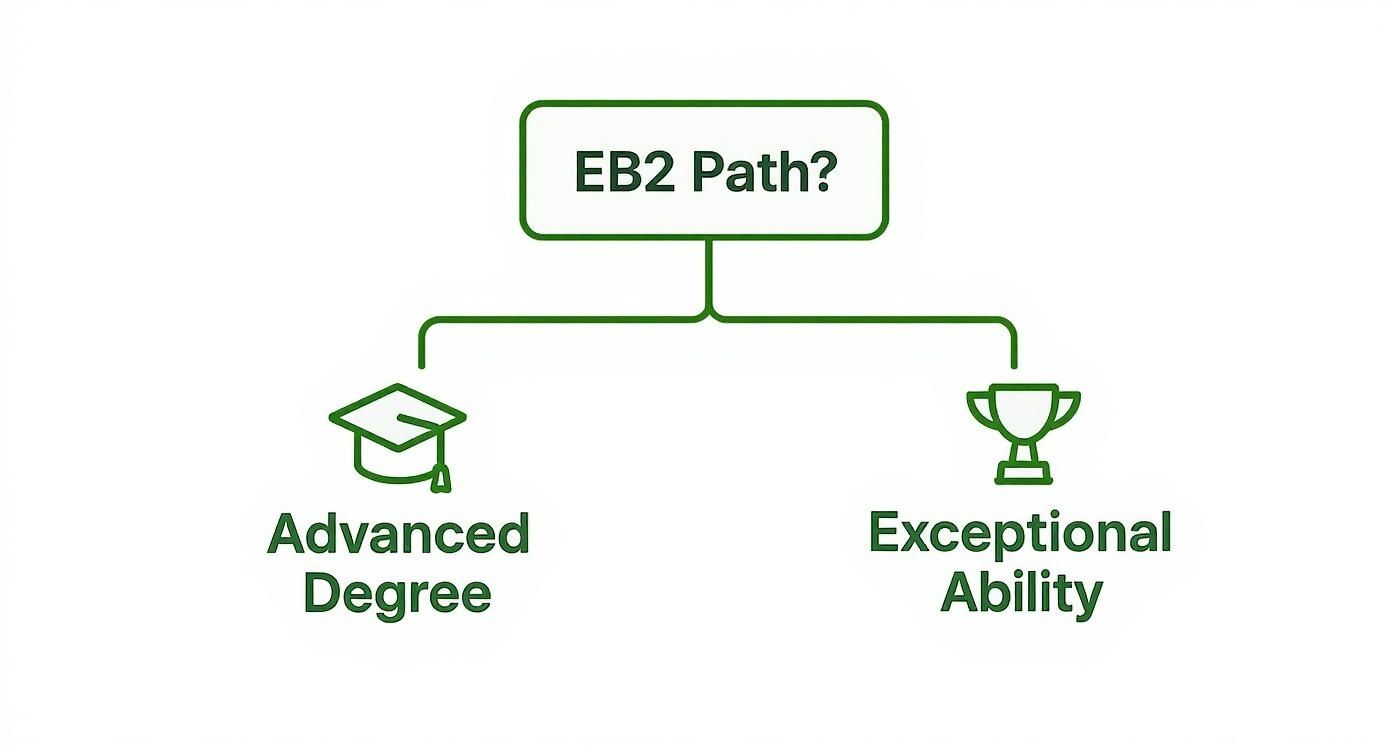
As you can see, no matter where you start, the destination is the same. The journey, however, can be radically different.
The Company-Led Route: PERM Labour Certification
By far, the most common way to get an EB-2 visa is with an employer's sponsorship. This is officially known as the PERM (Program Electronic Review Management) labour certification process. I like to call it the "company-led" route.
Here’s the deal: if a U.S. company wants to hire you for a permanent, full-time job, they first have to prove something to the U.S. Department of Labor. They must demonstrate that they couldn’t find a single qualified, willing, and able American worker for that specific role. This is no small feat; it involves a rigid and often lengthy recruitment process.
Let's say you're a talented data scientist in Abuja and a tech firm in America offers you a position. That company now has a long to-do list:
- Define the Job: They have to draft a precise job description, complete with minimum educational and experience requirements that perfectly match your profile.
- Test the Market: Next, they must advertise the job far and wide—think newspapers, online job boards, and other approved channels—to hunt for U.S. candidates.
- Prove No Takers: They are required to interview any qualified U.S. applicants and meticulously document legitimate, job-related reasons why none of them were a good fit.
Only after they've successfully shown that no suitable U.S. workers applied can the employer file the PERM application for you. If it gets certified, they can then move forward with the I-140 Immigrant Petition. The key takeaway is simple: the employer does all the heavy lifting, but your entire application is tied to that one job offer.
The Self-Sponsored Game-Changer: The National Interest Waiver (NIW)
But what if you don't have a job offer? Or what if your work is so significant that making an employer jump through the PERM hoops just doesn't make sense? This is where the EB-2 National Interest Waiver (NIW) comes into play, and it’s a total game-changer for many Nigerians.
The NIW is a powerful exception that lets you skip the entire PERM labour certification process. It's the "self-sponsored" route. By filing for an NIW, you're essentially making a direct appeal to the U.S. government, arguing that your work is so vital to the nation's interests that they should waive the need for a job offer and the labour market test.
The heart of a successful NIW petition is proving three core elements: that your proposed work has substantial merit and national importance, and that you are well-positioned to carry it out.
This path offers incredible freedom. You aren't tied to a specific employer, and you are in complete control of your petition. The trade-off? The burden of proof is entirely on your shoulders. You must build an airtight case demonstrating how your unique skills will benefit the United States as a whole.
NIW Examples for Nigerian Professionals
Let’s bring this to life with a few real-world examples for Nigerian professionals:
- A Public Health Researcher from Ibadan: Imagine a researcher at the University College Hospital (UCH), Ibadan, who has dedicated her career to studying infectious disease transmission. She could argue that her expertise in tracking diseases like Lassa fever is directly applicable to U.S. public health security. Her work has substantial merit (improving health outcomes) and national importance (protecting the U.S. population).
- An Agricultural Innovator from Kano: Consider an agricultural scientist from Kano who has pioneered new techniques for growing drought-resistant crops. He could build a compelling case that his innovations could help solve food security challenges and boost agricultural resilience in arid parts of the U.S., like California or Arizona. This work clearly serves the U.S. national interest.
While the NIW is a fantastic opportunity, it's vital to be aware of the changing landscape. After several years of very high approval rates, USCIS has increased its scrutiny. This means that a meticulously prepared case, clearly showing your value to the US, is more critical than ever. You can learn more about these recent EB-2 NIW approval rates and what they mean for skilled applicants.
Ultimately, choosing between the PERM and NIW paths is a strategic decision. It all comes down to your personal circumstances—whether you have a solid U.S. job offer or a powerful story to tell about your work's importance to the nation.
Building a Winning EB-2 Application: A Nigerian Checklist

Getting through the EB-2 visa process successfully all boils down to organised, compelling paperwork. Think of your application as a detailed proposal arguing for your professional value. Every single document you submit is another piece of evidence backing up your claim to be at the top of your game.
It’s easy to feel swamped by the requirements. To keep things manageable, let’s break down the essential documents into a clear checklist designed specifically for Nigerian professionals. This will help you gather exactly what you need, whether you're going for the Advanced Degree, Exceptional Ability, or NIW route.
Foundational Documents for All Applicants
No matter which EB-2 path you take, every application is built on a set of core personal documents. These are the non-negotiables. Get these sorted out first, and the rest of the process will feel much less intimidating.
- Valid International Passport: Simple but crucial. Make sure your passport has at least six months of validity beyond the date you plan to enter the U.S.
- Birth Certificate: You’ll need an official copy issued by the National Population Commission.
- Passport Photographs: Two identical colour photos. They must meet the specific U.S. visa photo requirements—don't just use any random passport picture you took for your NIN.
- Educational Credential Evaluation (ECE): This is a huge one for anyone with a Nigerian degree. USCIS needs to see official proof that your degree from UNILAG, OAU, or any other Nigerian university is equivalent to a U.S. degree. A WES (World Education Services) evaluation is considered the gold standard and is highly recommended.
Pro Tip: Start the WES evaluation process as soon as possible. Seriously. It can take weeks, sometimes even months, for your Nigerian university to send your transcripts directly to WES, and that’s a mandatory step. Don't let this be the reason for delay.
Evidence for the Advanced Degree Path
If your ticket is a master’s degree, or a bachelor’s degree plus five years of progressively responsible experience, your evidence needs to spell this out clearly.
Your documents must weave together a story of your academic and professional growth.
- Degree Certificates: Official copies of all your degrees (BSc, MSc, PhD).
- Academic Transcripts: The complete, official transcripts for all your post-secondary education.
- Letters Verifying Work Experience: These are not just simple "To Whom It May Concern" letters. Each letter from an employer (past or present) must detail your job title, dates of employment, specific duties, and—most importantly—show how your responsibilities grew over time to satisfy that "progressive" experience requirement.
Evidence for Exceptional Ability and NIW Paths
For those taking the Exceptional Ability or self-sponsored NIW track, the required evidence is much more extensive. You’re not just proving you have a degree; you're building a powerful case that proves your high standing and why your work matters on a national scale.
Your goal here is to present a portfolio that screams "leader in the field."
- Strong Recommendation Letters: These are mission-critical. They shouldn't be character references from friends or family. They must come from recognised experts and leaders in your field (both in Nigeria and internationally, if possible) who can speak directly to your specific contributions and influence. A huge part of this is securing compelling letters of recommendation; knowing how to ask effectively can make or break your case.
- Proof of High Compensation: Evidence showing you earn a salary, bonuses, or other payment that is significantly higher than others in your field. Think pay slips, tax documents, or detailed employment contracts from your Nigerian employers.
- Published Material About You: Have you been featured in the media? Articles in newspapers, trade journals, or major online publications that are about you and your work are powerful. A feature in a respected Nigerian outlet like TechCabal or The Guardian is excellent evidence.
- Awards and Honours: Any certificates or official letters for national or international awards that recognise excellence in your profession.
- Professional Association Memberships: Proof of membership in professional bodies, especially those that require outstanding achievements from their members to join.
- Evidence of Significant Contributions: This is where you show your impact. Think patents, research publications, or proof of the commercial success of your work that has genuinely moved your industry forward.
Tackling this checklist methodically will turn a daunting process into a manageable project, setting you on a clear path to a successful EB-2 application.
Navigating Timelines, Costs, and Common Mistakes
Taking the leap toward an EB-2 visa is a huge step that demands both patience and smart financial planning. Getting a clear picture of the time and money involved right from the start helps you set realistic goals and sidestep the kind of surprises that can throw your application off track. It’s important to remember this is a marathon, not a sprint.
The costs fall into a few main categories. While the figures here are estimates and can change, they’ll give you a solid baseline for your budget.
A Realistic Look at the Financial Commitment
The total cost for an EB-2 application can differ, but you should generally plan for two main expenses: government filing fees and, more often than not, legal fees.
- USCIS Filing Fees: These are the fixed, non-negotiable charges from the U.S. government. The main fee is for the Form I-140 (Immigrant Petition for Alien Worker), which currently sits at $715. Later, if you're eligible to file for Adjustment of Status with Form I-485, that comes with its own set of fees, roughly $1,440 (this usually includes the biometrics fee).
- Legal Fees: While it's possible to file on your own (especially for an NIW), most people choose to hire an immigration lawyer to get it right. Legal fees for an EB-2 case can vary quite a bit, from $5,000 to over $12,000, depending on how complex your case is. When you convert that to Naira at the current exchange rate, you're looking at a significant investment.
It’s better to see legal help not just as a cost, but as an investment in making your petition as strong and accurate as possible. A good lawyer can help you dodge common mistakes that lead to expensive delays or even a flat-out denial.
Demystifying the Application Timeline
The timeline for an EB-2 visa isn’t one single waiting period. It's a series of stages, and each one has its own processing time. Understanding this flow helps you mentally prepare for the long wait that often follows your initial submission.
One of the most important concepts you need to get your head around is your Priority Date. This is simply the date USCIS officially receives your I-140 petition. Think of it like taking a ticket at a counter—it secures your place in the queue for a visa. As a Nigerian, you fall into the "Rest of World" (ROW) category, which is good news because it usually means a shorter wait compared to countries with massive backlogs like India or China.
You'll need to keep an eye on the monthly Visa Bulletin to see when your Priority Date becomes "current." That’s the green light, telling you it’s your turn to move to the final stage. The journey itself can be unpredictable. For employment-based petitions like the EB-2, the average processing time for the I-140 has been around 6.7 months, though it has bounced between 5.2 and 8.2 months recently. With a huge backlog of over half a million cases pending in 2024, delays are a very real possibility. You can find more insights about current green card statistics and trends on Docketwise.
Common Mistakes Nigerian Applicants Must Avoid
So many promising applications from Nigeria get weakened by simple, avoidable errors. Knowing what these common pitfalls are can seriously boost your chances of success.
- Improper Credential Evaluation: Just sending in your Nigerian degree certificate won’t cut it. You absolutely must have it evaluated by a designated U.S. agency like WES to prove it’s equivalent to a U.S. degree. Failing to do this is a classic mistake that often leads to a Request for Evidence (RFE) or an outright denial.
- Weak Evidence of Progressive Experience: If you're using the "BSc + 5 years" route, your proof has to be ironclad. The letters from your employers need to do more than just state your job title and dates; they must spell out exactly how your responsibilities and skills grew over those years. A generic letter is a red flag.
- Underestimating NIW Evidence: For a National Interest Waiver, the standard of proof is incredibly high. A lot of applicants fall short because they don't provide enough objective evidence showing their work is important on a national scale. Your own statements aren't enough—you need hard data, letters from other experts, media mentions, and anything else that builds a powerful, undeniable case.
- Misrepresentation: This is the big one. Never, ever provide false information or fake documents. The consequences are severe and can get you permanently banned from the U.S. Honesty is everything. It’s crucial to understand what counts as visa application misrepresentation and its serious outcomes.
Where Do You Go From Here? Your Path to a US Green Card
Navigating the EB-2 visa process can feel like a huge undertaking, but it’s a well-defined path to an incredible future. For Nigeria’s brightest professionals, this isn't just a dream; it's an achievable goal. You already have the talent and the drive—now it's just a matter of putting together a compelling application that proves it.
Think back to the two main routes we covered. The Advanced Degree path is a solid fit if you hold a master's degree or a bachelor's with five years of progressive experience. On the other hand, the Exceptional Ability path is designed for those who have clearly risen to the top of their profession. You can approach either of these with a company sponsoring you through the PERM process, or you can go it alone with the National Interest Waiver (NIW) for more control over your career.
So, what's the very next thing you should do?
Charting Your Course
Let's turn all this information into a concrete plan. Here are the immediate steps you can take to get the ball rolling:
-
Do a Proper Self-Assessment: Take a serious, honest look at your career and qualifications. Which path—Advanced Degree or Exceptional Ability—is the best showcase for your unique strengths? Be completely realistic about the documents and evidence you can actually get your hands on.
-
Start Gathering Your Documents Now: Seriously, don't put this off. Begin the process of requesting official transcripts from your university in Nigeria so you can get your credentials evaluated by WES. At the same time, contact your past and current employers for detailed letters confirming your work experience. Getting a head start on this will save you a world of stress later.
-
Find an Experienced Immigration Lawyer: This isn't a step to skip. A good lawyer, especially one who gets the unique challenges and opportunities for Nigerian applicants, can be the deciding factor. They can spot weaknesses you might miss and help you build the strongest case possible.
Remember, this is a marathon, not a sprint. Every document you collect and every step you take brings you one step closer to your goal.
Burning Questions from Nigerian EB-2 Applicants
As you get deeper into the EB-2 visa process, questions are bound to come up. That’s perfectly normal. Getting straight answers is the best way to keep your confidence high, so let’s dive into some of the most common questions we hear from Nigerian professionals like you.
Can I Really Apply for the EB-2 NIW from Nigeria Without a U.S. Job Offer?
Yes, you absolutely can. This is the standout feature of the National Interest Waiver (NIW) and what makes it so attractive. It’s a self-petition, which means you don't need a U.S. company to sponsor you or offer you a job.
Instead of focusing on an employer, your entire NIW application is about you and your work. Your goal is to convince U.S. immigration that what you do is important to the United States and that you have a solid plan to continue that work once you arrive.
How Can I Prove My 5 Years of Progressive Experience from My Jobs in Nigeria?
This is where your documentation has to tell a story. You'll need detailed employment verification letters from all your relevant employers in Nigeria—both past and present. These letters need to go far beyond simply stating your job title and employment dates.
Each letter should paint a clear picture of your role, specifically outlining your duties and showing how your responsibilities expanded over time. Think of it as a certified summary of your career progression, signed by a manager or HR. To make your case watertight, include supporting evidence like promotion letters, official performance reviews, and even notices of salary increases. These documents prove your growth wasn't just on paper.
My Priority Date Isn't Current. What Does That Mean for Me?
Your priority date is simply the date USCIS officially received your I-140 petition. It's your place in the line for a visa. When you check the monthly Visa Bulletin and see your date isn't "current" yet, it just means you have to wait a bit longer before you can move to the final stage, which for applicants in Nigeria is consular processing in Lagos.
It's crucial to understand that this waiting period does not harm your case in any way. Your petition remains approved and valid. You just need to be patient for your turn in the queue.
The good news? Nigeria is in the 'Rest of World' category, which typically means much shorter waits compared to countries with huge backlogs. Keep a close eye on the Visa Bulletin, published monthly by the U.S. Department of State, to track your progress and know when it’s your time.
Planning your move abroad requires accurate information and a solid strategy. JapaChat is here to provide the clarity you need. As Nigeria’s AI immigration expert, we offer instant answers to your visa questions and provide tools to help you organise your journey with confidence. Start planning your future today by visiting https://japachat.com.
Leave a Reply