
New Brunswick Critical Worker Pilot Program: A Guide for Nigerians

If you're a skilled worker in Nigeria feeling lost in the vast and competitive Express Entry pool, there’s a more direct pathway you should know about. The New Brunswick Critical Worker Pilot Program is an employer-driven stream that connects you with a genuine job offer and a clear path to permanent residency.
Forget thinking of it as another visa lottery. This is more like a targeted recruitment drive by some of New Brunswick’s biggest companies, and it's looking for people with your exact skills.
What Is the New Brunswick Critical Worker Pilot Program?

Let's say you're an experienced machine operator in Lagos or a food production supervisor in Ibadan. You've got solid, hands-on skills, but you're finding it tough to compete in broader immigration programmes like Express Entry, which often seem to favour candidates with advanced degrees or high-level management experience.
The New Brunswick Critical Worker Pilot Program (NBCWP) was designed with exactly you in mind.
This programme doesn't rely on points or random draws from a giant pool of candidates. Instead, it's a straightforward, employer-led initiative. What that means is the entire process kicks off with a real job offer from a company in New Brunswick that genuinely needs someone with your expertise. It’s a five-year pilot created to fill urgent labour shortages with skilled international talent.
A Partnership Between Employers and Immigrants
At its heart, this programme is a collaboration between you and one of six specific, pre-approved companies. These aren't just any businesses; they are major players in their respective industries with a solid history of hiring and integrating newcomers successfully.
They were handpicked because they offer more than just a pay cheque. They provide a complete support system to help you and your family get settled and truly build a life in New Brunswick.
The pilot was officially launched on November 7, 2022, and for now, it's focused on just six key employers who have demonstrated their commitment to supporting foreign workers.
The 6 Designated NBCWP Employers
This table lists the only six companies participating in the pilot, helping you quickly see if your skills align with their industries.
| Company Name | Primary Industry |
|---|---|
| Cooke Aquaculture | Aquaculture and Seafood Processing |
| Groupe Savoie | Forestry and Hardwood Manufacturing |
| Groupe Westco | Poultry Farming and Processing |
| Imperial Manufacturing Group | HVAC and Building Material Manufacturing |
| J.D. Irving, Limited | Diversified (Forestry, Shipbuilding, Transport) |
| McCain Foods, Ltd. | Food Processing (Frozen Foods) |
These employers were chosen specifically for their ability to provide not just jobs, but also comprehensive settlement support, from housing to language training.
Why This Programme Is Different
Unlike many immigration pathways that can feel confusing and uncertain, the NBCWP offers a clear, structured route. Once one of these six employers hires you, you’re basically on a fast track.
The programme is designed to solve real-world problems for New Brunswick's economy by targeting the critical roles that keep its most important industries moving forward.
This employer-driven model significantly boosts your chances of success. Your application isn't just another number in a queue; it's directly tied to a specific, in-demand job, which gives it immediate priority.
For hands-on workers ready to bring their skills to Canada, this pilot is a game-changer. By connecting you directly with major employers, it helps you sidestep much of the competition and uncertainty of other streams, making your dream of a Canadian permanent residency application feel much more within reach.
So, Do You Qualify? Let's Break Down the Eligibility Requirements
Before you start imagining your new life in New Brunswick, you need to be brutally honest about whether you fit the bill. This isn't your typical immigration pathway; the New Brunswick Critical Worker Pilot Program has a very specific type of person in mind. Think of these requirements less as hurdles and more as a checklist to see if this unique opportunity is truly for you.
The absolute first step—your golden ticket, really—is securing a full-time, permanent job offer from one of the six participating employers we mentioned earlier. Without that specific job offer, your application can't even get off the ground.
Once you have that, let's look at the other boxes you need to tick. I'll break it down with some practical advice specifically for my fellow Nigerians.
Age and Your Commitment to New Brunswick
First up, the easy part: you must be between 19 and 55 years old. Your age is counted at the moment you submit your official application, not when you first show interest.
But it's not just about your age. You also have to genuinely prove you intend to settle in New Brunswick. This isn't a backdoor to get into Canada and then move to a bigger city like Toronto. You’ll need to demonstrate real plans to put down roots and build a life in the province.
Your Education: Getting It Recognised
You'll need at least a Canadian high school diploma or its foreign equivalent. For most Nigerians, this means your WAEC or NECO certificate will do the trick, but there’s a vital step you can’t skip.
You must get your certificate evaluated by a designated body like World Education Services (WES). This process is called an Educational Credential Assessment (ECA), and it officially verifies that your Nigerian qualification is on par with a Canadian one. Make sure your ECA report is less than five years old when you apply.
An ECA is non-negotiable. One of the smartest things you can do is start your WES evaluation early, as it can take a few months. Think of it as laying the proper foundation for your entire application.
Proving Your Language Skills
You'll need to show you can communicate in either English or French by taking an approved language test. For English, that's usually the IELTS General Training or CELPIP.
The bar here is set at a Canadian Language Benchmark (CLB) level 4 across all four abilities: reading, writing, listening, and speaking. A CLB 4 is pretty basic; it just shows you can handle simple, everyday conversations and follow instructions at work. Your test results must be fresh—less than two years old.
Work Experience: The Most Important Piece of the Puzzle
This is where the programme really narrows its focus. You must have at least 1,560 hours of work experience within the last five years. That’s the equivalent of one year working full-time (about 30 hours per week).
The real kicker is the type of work. Unlike many Provincial Nominee Programs (PNPs) that hunt for highly skilled professionals, the New Brunswick Critical Worker Pilot is specifically designed for low and semi-skilled workers. We're talking about roles classified under TEER 4 and 5 of the National Occupational Classification (NOC). This is because New Brunswick has major labour shortages in sectors like food production, forestry, and manufacturing.
So, what does that mean for you?
- Who this is for: People who are machine operators, food processing labourers, fish plant workers, or general farm workers.
- Who this is NOT for: IT managers, accountants, doctors, or engineers. This pilot is all about hands-on, operational roles.
Every bit of your work experience has to be verifiable. It’s a good idea to understand how employment history is verified because they will check. Make sure your reference letters and employment records are crystal clear and accurate—this will be key.
Your Document Checklist for the NBCWP Application
Let's be honest, gathering documents is the part of any Canadian immigration process that can feel overwhelming. For the New Brunswick Critical Worker Pilot, getting organised from the very beginning isn't just a good idea—it's essential.
Think of it like preparing for a major exam. You wouldn't just show up on the day and hope for the best. You'd gather your notes, study, and have everything ready. This checklist is designed to be your study guide, specifically for Nigerian applicants, highlighting common hurdles like getting university transcripts or properly documenting your finances.
Let's walk through exactly what you need to pull together for a solid, refusal-proof application.
Foundational Identity Documents
This first batch of documents is all about proving who you are. These are the absolute basics, the foundation of your entire application. Make sure every copy is crystal clear and every document is valid.
- International Passport: Your passport is your key. It must be valid, with at least a year left before expiry and several blank pages. You'll need to scan the bio-data page for yourself and every family member coming with you.
- Birth Certificate: The official certificate issued by the National Population Commission is what you need. If your birth predates the commission, a sworn affidavit declaring your age, obtained from a high court, is the standard alternative.
- Marriage Certificate: If you're married and your spouse is part of your application, this is a must-have.
- Passport Photographs: Don't just snap a quick picture on your phone. You need recent, professional digital photos that meet the strict Canadian immigration specs – white background, neutral look, and the right size.
Proving Your Education and Language Skills
This is where you show you meet the program's standards for education and communication. This section is a common source of delays for many Nigerian applicants, so give it your full attention right from the start.
First up, you absolutely must get an Educational Credential Assessment (ECA). For most of us in Nigeria, this involves sending our WAEC results or university degree certificates to a designated body like World Education Services (WES) to have them assessed against Canadian standards. This process can drag on for months, especially when you're chasing transcripts from Nigerian universities. My advice? Start this process immediately.
Your language test is non-negotiable proof that you can communicate effectively. You'll need to submit a valid IELTS General Training or CELPIP result that shows you've hit at least the Canadian Language Benchmark (CLB) 4. Critically, the test must have been taken within the last two years when you submit your application.
Showing Your Work History and Financial Readiness
Here's where you prove you have the hands-on experience and the money to get started in New Brunswick. Canadian immigration officers are incredibly meticulous here, especially when it comes to your settlement funds.
For your work experience, you'll need to gather:
- Reference Letters: These aren't just simple notes. They must be on official company letterhead and clearly state your job duties, salary, and the exact dates you worked there.
- Payslips: Pull together at least your last six months of payslips as proof of consistent employment.
- Employment Contract: Your current work contract is another powerful piece of evidence to include.
When it comes to your finances, you have to prove you have enough settlement funds to support your family when you land. This money must be yours, easily accessible, and not borrowed. We've put together a comprehensive guide on this, and I highly recommend you read it: proof of funds for a Canadian visa.
Documenting funds from common Nigerian sources, like selling a property or receiving a cash gift from a relative, requires extra care. You may need to provide a sworn affidavit to explain the source of these funds or clarify other personal details. If you're not sure what that involves, understanding affidavit requirements is a great starting point to make sure your financial documents are accepted without question.
NBCWP Document Checklist
To make this even easier, I've organised everything into a simple table. Use this to track what you have and what you still need to get.
| Document Category | Specific Item | Helpful Tip for Nigerian Applicants |
|---|---|---|
| Identity & Personal | Valid International Passport | Ensure at least one year of validity. Scan the bio-data page clearly. |
| Birth Certificate | Use the one from the National Population Commission or get a court affidavit for age. | |
| Marriage Certificate | Required if your spouse is included in the application. | |
| Passport Photographs | Get professional digital photos; selfies or old pictures will be rejected. | |
| Education & Language | Educational Credential Assessment (ECA) | Start the WES (or other) process immediately; transcript delays are very common. |
| Language Test Results (IELTS/CELPIP) | Must be less than two years old and show a minimum of CLB 4. | |
| Work Experience | Employment Reference Letters | Must be on official letterhead with detailed job duties, dates, and salary. |
| Payslips | Provide at least the six most recent ones. | |
| Employment Contract | Your current, signed contract is strong supporting evidence. | |
| Financial | Proof of Funds Statements | Bank statements showing accessible funds. Read the detailed guide linked above. |
| Affidavit of Fact (if needed) | Crucial for explaining large gifts, property sales, or other complex fund sources. |
Having all these documents in hand before you even think about hitting 'submit' will make your journey smoother and significantly boost your chances of success.
Your Step-by-Step Application Guide
Think of applying for the New Brunswick Critical Worker Pilot Program like planning a road trip from Lagos to Abuja. You wouldn't just jump in the car and hope for the best. You'd map your route, figure out your stops, and make sure you have everything you need for the journey. This section is your personal roadmap, breaking down each stage so you know exactly what to expect.
Unlike the massive Express Entry pool where you just create a profile and wait, this pilot has a very specific, non-negotiable starting point.
Step 1: Getting a Genuine Job Offer
This is the make-or-break step. Everything hinges on it. You absolutely cannot apply for this program unless you have a full-time, permanent job offer from one of the six participating companies.
So, forget browsing general job sites like Indeed or LinkedIn for this. Your search needs to be laser-focused.
Head directly to the careers pages for Cooke Aquaculture, J.D. Irving, Groupe Savoie, Groupe Westco, Imperial Manufacturing Group, and McCain Foods. Make sure your CV is tailored to Canadian standards and write a compelling cover letter that shows you've done your homework on their company and the specific role you want.
The key here is to think like you're applying for a job, not for immigration. Your first mission is to convince one of these companies that you're the best person for the role based on your skills. The immigration part only kicks in after they’ve decided to hire you.
Step 2: The Provincial Nomination Process
Once you’ve landed that golden job offer, the formal immigration journey begins. This stage is handled directly by the province of New Brunswick and has two key parts.
- Submit an Expression of Interest (EOI): Your new employer will point you towards the Immigration New Brunswick (INB) online portal. You'll create a profile and fill in your details—age, education, language skills, and work history. While your profile goes into a pool with others, having a job offer from a designated employer means your selection is virtually a sure thing.
- Get an Invitation to Apply (ITA): Soon after submitting your EOI, you'll receive an official Invitation to Apply from the province. This is your green light to submit a full application for provincial nomination. You’ll have a tight deadline of 45 days to get all your documents in, so preparation is everything.
This image neatly summarises the main document categories you'll need to have ready.
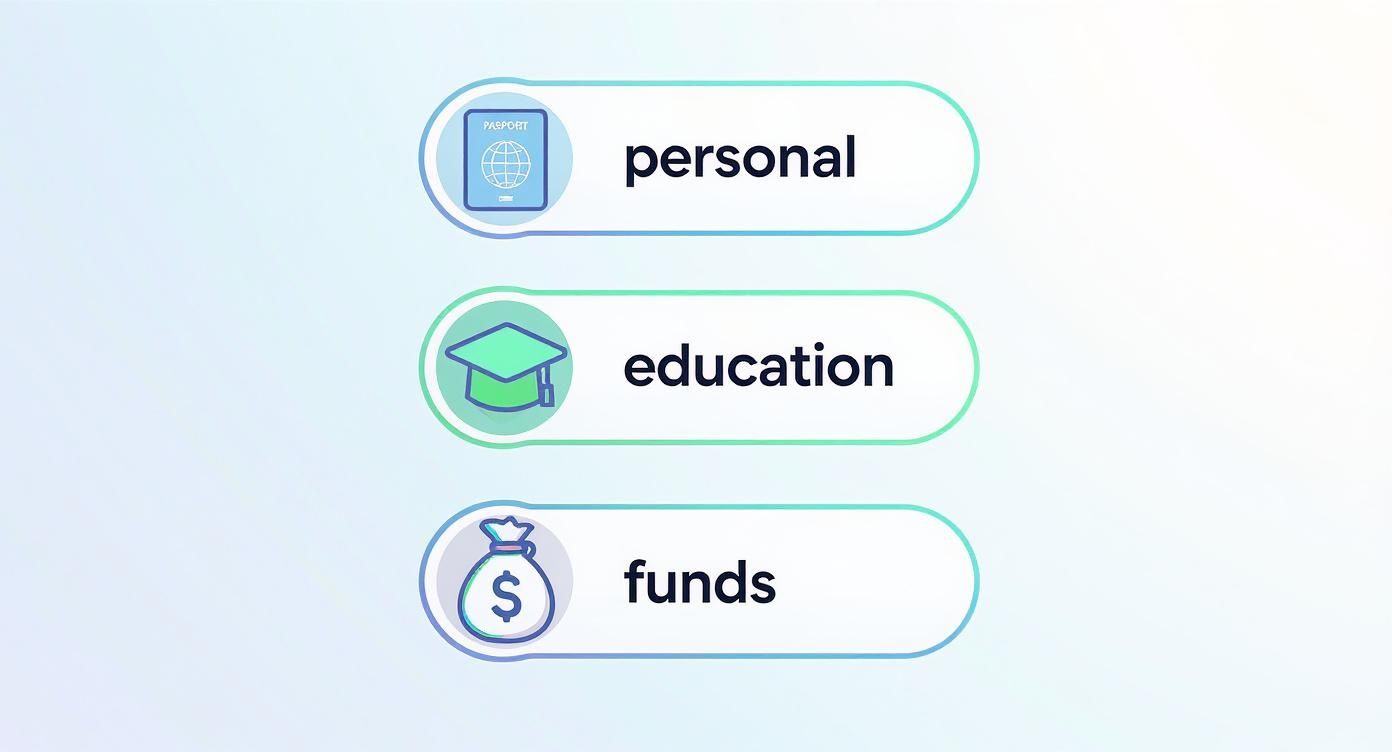
Think of these as the three pillars of your application: your personal identity, your qualifications, and your financial standing. Each one needs to be rock-solid.
Step 3: Applying for Permanent Residence with the Federal Government
After New Brunswick gives your application the thumbs up, they'll issue a nomination certificate. This is a massive win, but you're not at the finish line just yet. This certificate is your golden ticket to apply for permanent residency at the federal level with Immigration, Refugees and Citizenship Canada (IRCC).
You'll then submit another, more detailed application to IRCC. This package will include your provincial nomination certificate, medical exam results, police clearance certificates, and proof of settlement funds. Often, you can also apply for a work permit at this stage, which allows you to move to New Brunswick and start your job while your PR application is being finalised. For a deeper dive into that, our guide on the Canada work visa permit is a great resource.
What to Realistically Expect for Timelines
Patience is a virtue in any immigration journey, and this one is no different. The process takes time, so it's best to be prepared for the wait.
- Provincial Stage (EOI to Nomination): This part can take up to 6 months.
- Federal Stage (PR Application): Once you submit to IRCC, expect to wait another 15 months or more.
All in, you should be prepared for a total processing time of about two years from the day you get your ITA from New Brunswick. Knowing this roadmap from the start makes the whole multi-stage process feel a lot less daunting and much more achievable.
Comprehensive Settlement Support for Your Family

Moving your entire family to a new country is a massive undertaking. The list of worries can feel endless: Where will we live? How will we get around? What about the language barrier? The New Brunswick Critical Worker Pilot Program was specifically designed to help quiet many of these fears.
What really makes this pilot stand out from nearly every other immigration pathway is the mandatory, robust settlement plan your employer must provide. This isn't just about handing you a job offer; it’s a genuine commitment to giving your family a "soft landing."
This support is a non-negotiable part of the deal for the six participating employers. They weren't picked at random; they were chosen because they have a proven history of helping newcomers not just arrive, but truly settle in and succeed in their new communities.
Your Practical Support System on Arrival
Picture this: you and your family have just landed at the airport in Moncton or Fredericton. Instead of facing the immediate stress of finding a taxi and navigating a brand-new city, your employer has already arranged transportation to take you straight to your new home. This is the exact kind of practical, on-the-ground support the program guarantees.
This assistance is all about solving the immediate problems that cause the most stress for Nigerian families moving abroad. The aim is to get you settled in as quickly and smoothly as possible so you can focus on your new job and helping your family adjust.
Key areas of support you can expect include:
- Housing Assistance: Your employer will help you find a suitable and affordable apartment or house for your family, often before you even step on the plane.
- Transportation Arrangements: This covers everything from coordinating your pickup from the airport to helping you get your head around local transport, like bus routes or the process of getting a driver's licence.
- Community Integration: They'll connect you with local community centres, point you to grocery stores that might stock familiar African foods, and help you find recreational activities for your children.
This level of hands-on support is a complete game-changer. It turns what could be a stressful, solo struggle into a guided transition, making your family's move into New Brunswick life much smoother and faster.
Language Training and Skills Development
Another powerful feature of the settlement plan is the focus on language training. Your employer is required to offer up to 200 hours of language classes, which is crucial for building your confidence at work and in your everyday life.
This isn't just about passing an exam; it's about real-world communication. The training helps you understand instructions on the job, have a chat with your neighbours, and even help your children with their homework. It’s a real investment in your long-term success here.
Beyond language, the support often extends to skills development. These employers are committed to helping you grow in your career. They provide on-the-job training to help you adapt your existing skills to Canadian standards and open up pathways for advancement within the company. This focus on building a long-term career is a major benefit of this unique pilot program, setting you and your family up for a successful future in New Brunswick.
Got Questions? We've Got Answers for Nigerian Applicants
If you're looking at this program from Nigeria, you probably have a lot of questions swirling around. It's completely normal. The New Brunswick Critical Worker Pilot is a fantastic opportunity, but it's different from other pathways. Let's tackle some of the most common questions I hear from Nigerian applicants, so you can move forward with confidence.
Do I Really Need an Agent to Apply?
This is the big one, and the answer is a straight-up no. You absolutely do not need to pay an agent in Nigeria to get into this program.
The entire pilot is built on a direct relationship between you and one of the six participating companies. Your job is to focus on polishing your CV to a Canadian standard and applying directly for roles on their official websites. That's it.
While you can choose to hire a licensed Canadian immigration consultant for advice, it’s not a requirement. Please be very careful. If someone in Nigeria is promising you a guaranteed job offer for a fee, it's almost certainly a scam. This process is between you, the employer, and the government—there’s no need for a middleman.
Your skills and a genuine job offer are what get you in, not how much you pay an agent. Hold onto your money and deal directly with the companies.
Can I Bring My Family With Me?
Yes! This is one of the best parts of the New Brunswick Critical Worker Pilot. It’s a direct route to permanent residency, which means your family is included from day one.
Who counts as family?
- Your spouse or common-law partner.
- Your dependent children (usually under 22 years old, as long as they aren't married or in a common-law relationship).
When your application gets the green light, your whole family becomes permanent residents at the same time. This programme isn't just about filling a job; it's designed to help families settle down and build a new life in New Brunswick.
How Much Money Do I Need for Proof of Funds?
Okay, let's talk about "settlement funds." The amount you need isn't set by New Brunswick; it's a federal government requirement that changes every year. How much you need depends entirely on the size of your family. Before you do anything, you must check the latest figures on the official IRCC website.
To give you an idea, the numbers for early 2024 look something like this:
- 1 person: CAD $13,757
- 2 people: CAD $17,127
- 3 people: CAD $21,055
- 4 people: CAD $25,564
Now, here's the crucial part: this cannot be borrowed money. You have to prove the funds are yours and easily accessible. For Nigerians, this means you need solid paperwork like:
- Six months of official bank statements.
- Fixed deposit certificates from a good Nigerian bank.
- Legal documents from the sale of a property, showing the money hitting your account.
- If a large sum was a gift, you'll need a sworn affidavit from the person who gave you the money, explaining why.
A large amount of cash suddenly appearing in your account right before you apply is a major red flag. They want to see a clear history of where the money came from.
What’s Life Actually Like in New Brunswick?
If you're coming from a bustling city like Lagos, Port Harcourt, or Abuja, prepare for a big change of pace. It's important to be real about this. New Brunswick is known for being quiet, friendly, and surrounded by beautiful nature.
Let's break it down:
| Aspect of Life | Lagos/Abuja | New Brunswick |
|---|---|---|
| Pace of Life | Go, go, go! It's fast, high-energy, and never stops. | Much slower and relaxed. People take their time. |
| Cost of Living | Can be very expensive, especially for decent housing. | Way more affordable. Your money goes a lot further, especially for rent. |
| Environment | Urban jungle, lots of people, and legendary traffic. | Lots of green space, forests, and coastline. Think fresh air! |
| Nigerian Community | Huge and well-established. | Smaller but growing fast. You'll be part of building the community. |
And yes, the weather is a huge factor. The winters are cold, with plenty of snow, which will be a new experience. But the good news is that the settlement support from your employer is designed for this. They'll help you with everything—from figuring out what winter coats to buy and registering your kids for school, to connecting you with local services to make sure you and your family feel at home.
Ready to start planning your move with expert guidance? JapaChat is Nigeria's first AI immigration expert, designed to answer your specific questions about visa requirements, documentation, and creating a successful immigration strategy. Get instant, accurate advice and build your relocation plan with confidence. Sign up for free at JapaChat.
Leave a Reply